Caustic soda supply on 25 m²: a new system for the Kulmbach Brewery
The challenge
Kulmbacher Brauerei AG has completely overhauled its central caustic soda supply system at its Kulmbach site. The existing system could no longer be used due to changes in operational conditions. This involved more than just a new storage tank: the reception of tanker lorries, storage, dilution and supply to the connected consumers were to be planned and implemented as an integrated system. The spatial constraints posed a particular challenge: only around 25 m² of floor space was available for the entire system. The site processes quantities of concentrated caustic soda each year equivalent to around 30 tanker deliveries. The chemical is delivered as a 50 per cent concentrate and is then diluted on site to the required application concentration.
The sera solution
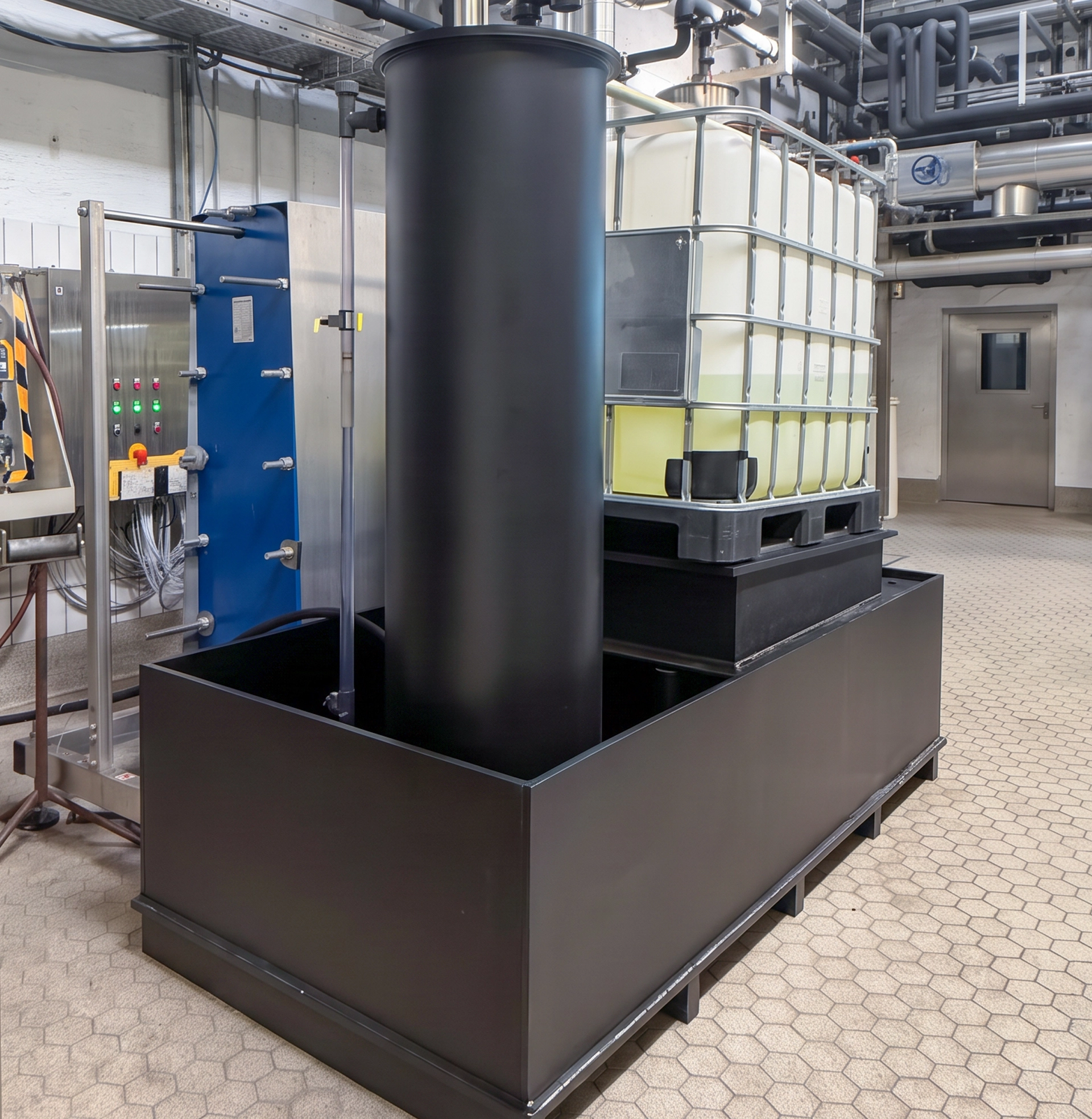
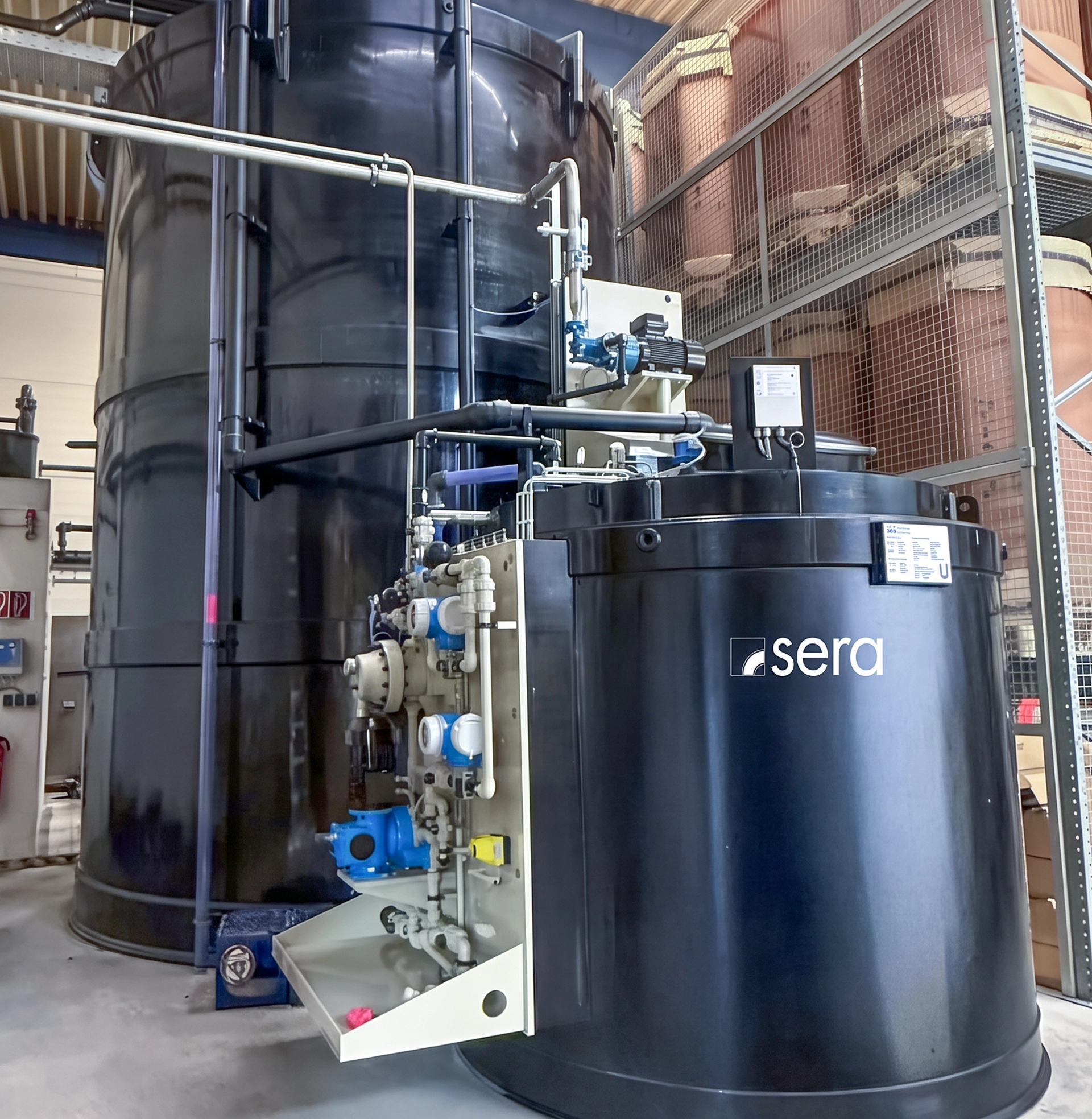
Together with Kulmbacher Brewery, sera developed a plant concept that integrates the individual process steps of the caustic soda supply. Delivery takes place via an outdoor reception cabinet. From there, a pipeline leads to a 35-m³ storage tank inside the building. As concentrated caustic soda tends to crystallise at low temperatures, the external pipework is insulated and fitted with trace heating. Heating has also been provided for the storage tank. Existing hot process water can be used for this purpose. The polyethylene storage tank is situated in a spill tray and is fitted, amongst other things, with measuring probes for level detection and overflow protection.
From the storage tank, the concentrated caustic soda is fed to the dilution station. There, water is added to adjust it to the concentration required for operation. A sera RF410.2-900e dosing pump draws the concentrate from the top of the approximately 5.5-metre-high storage tank via a suction lance. An automatic lifting device assists the suction process. The diluted caustic soda solution is then stored in a 5 m³ daily storage tank. If the level falls below a defined threshold, further solution is produced automatically. From there, it supplies various points of use within the brewery, including CIP systems, the keg filling line and the bottle filling line. Communication between the individual system components is managed via a PLC control system.
A particular challenge was the installation of the storage tank. Measuring approximately 5.5 metres in height and 3.5 metres in diameter, the tank had to be transported into the building lying on its side on heavy-duty rollers and only erected once inside. Its dimensions result in a diagonal span of around 6.5 metres. At the relevant point, there was only around 6.55 metres of headroom available between the steel beams of the ceiling structure. Erecting and positioning the tank therefore required precise coordination between the trades involved.
Following the award of the contract in September 2025, planning, fabrication and installation took place. Parts of the external pipework were delayed during the winter months due to weather conditions. Once the mechanical and control system components had been installed and connected, the switch from the existing to the new caustic soda supply was carried out whilst the brewery remained in operation. The plant was commissioned in March 2026.
sera was responsible for the planning and implementation of the entire system – from the reception of tankers, through storage and dilution, to the integration of the connected consumers. The scope of the project also included mechanical and electrical integration, pipework, commissioning and the training of operating staff.
The benefits for the customer
- Centralised supply to various on-site consumers
- 35 m³ storage tank for concentrated caustic soda
- Automated dilution to the specified application concentration
- 5 m³ daily storage tank
- Automated communication between system components
- Planning, installation, commissioning and training as part of a single project
Conclusion
With the new central caustic soda supply system, the reception of tankers, storage, dilution and supply to the connected consumers are technically integrated. The project demonstrates how a centralised chemical supply system can be integrated into existing production structures, even where space is limited and structural conditions are challenging.